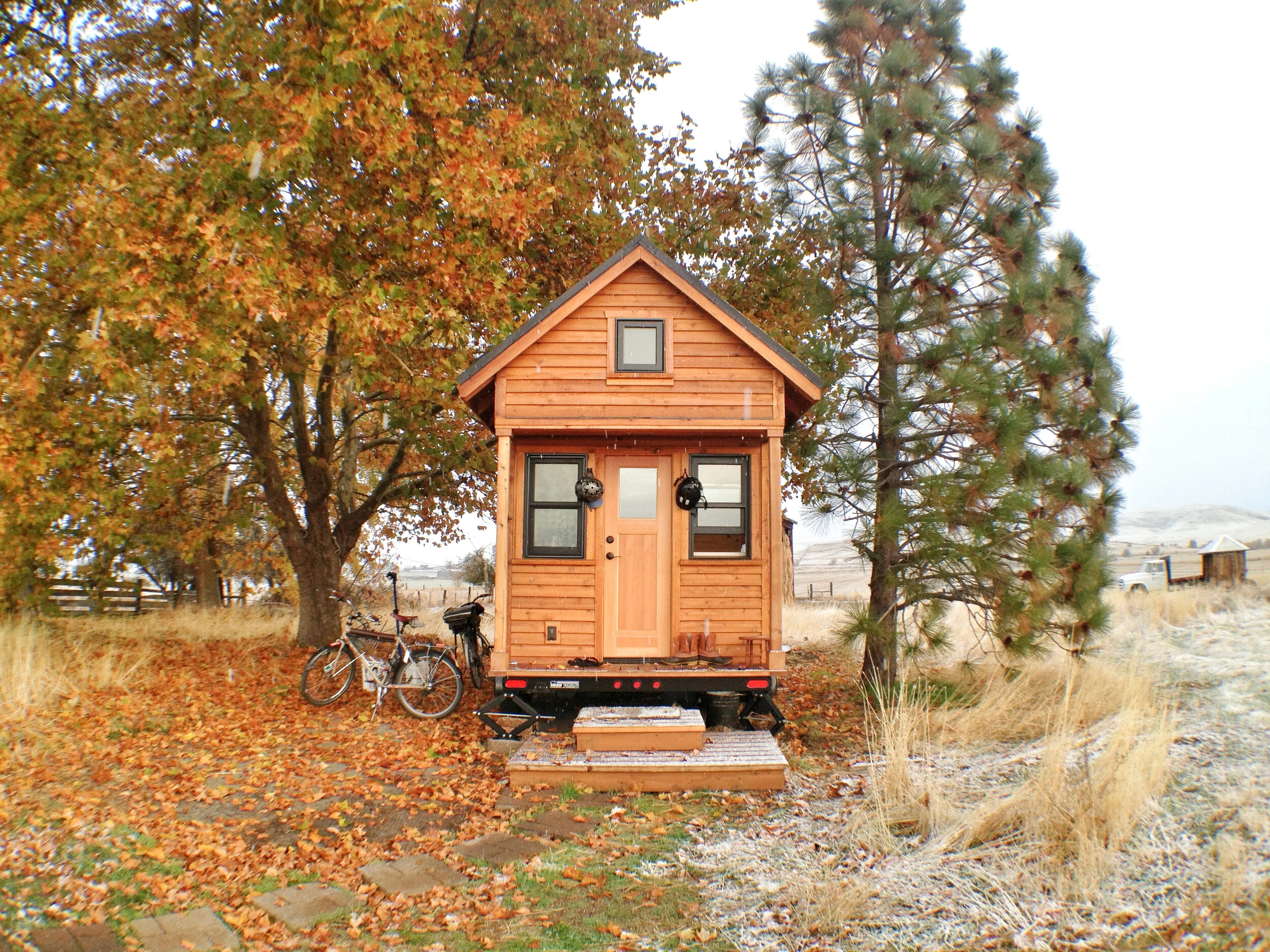
Our Tiny House

Our tiny house is complete and we’re all moved in! For the full backstory about the little house, read this post. Be sure to check out the photos and the Q & A below.

A Look Inside


- – - – -

Moving Day

- – - – -

The Building Process

- – - – -

Q & A

I’ve been getting a lot of inquiries about our little house. To avoid answering the same questions over and over, I complied a brief Q & A. Please read through this before you email me questions! Thanks in advance.

How many square feet is the dwelling? What about multipurpose rooms?

About 150 square feet. It’s being built on a 8 x 16 foot trailer.

The whole space is multipurpose. For example, in the “great room” (the lower level of the house), we’ll have a fold out desk that will also be a small dinning room table.

Really it’s all about how you design a space and what suits your needs. For more design ideas, I highly recommend reading Little House on a Small Planet. The book contains a wealth of information about living and design small spaces. Plus the author profiles families who live in little homes.

Who built your little house?

Dee Williams designed the house and Katy Anderson is building it. For more information, visit Portland Alternative Dwellings.

How much did the house cost?

$33,000.

How will you have any sense of privacy or personal space?

If I need space I go outside or do yoga. As a writer, I already spend a lot of time alone and more time away from Logan than I would like. Logan is my best friend, partner, and I love him like crazy. So when he’s home, spending time with him is a joy. Also, we will have a buffer spaces in the house. There will be a loft (our bedroom) and the great room.

Will you have storage space?

There will be plenty of storage space in the little house.

If you look at the rough sketch of the little house, you’ll see a bump out couch. Under the couch will be storage space. In addition, we’ll have a small closet, pantry, small kitchen cabinets, and storage space in the loft. And remember, we don’t have that much stuff.

For more, read this article and paper and books.

Will it be close to town so you can commute easily?

Right now we’re planning on parking the little house in North Portland. The location will be close to town and Logan will have an easy commute to work.

Where will guests sleep?

Guests can either stay in the loft or we’ll put them up at a lovely hotel.

Will you have a porch and room for a garden?

Yes, we will have a porch and a garden too! We’d love to have kitchen garden planters outside the windows and hopefully we’ll have permission to garden wherever we park.

Are you planning on having children?

No, we are not having children. But keep in mind, it is possible to have kids and live in small spaces. If you need design ideas read Little House on a Small Planet.

What about the building codes?

If you want to build a little house, check in with your local city planning department because building codes vary from city to city. Some cities are more flexible than others. Luckily, the City of Portland’s Planning Department has been supportive of building small, sustainable homes.

For more on Portland tiny homes, check out the post I wrote for Kent last year.

Where does your poop go?

Well, that’s an awfully personal question. :)

In all seriousness, we will be using a composting toilet. Composting poo is a huge topic. If you want to learn more, listen to The Pee & Poo Show and read the Humanure Handbook.

Can you tell us about your cute little stove?

The stove/oven is an Origo 6000 and its used predominately on boats. It uses alcohol as fuel so its safe to burn indoors with minimal ventilation and its free standing (no pipes or wires it just sits in the counter). We watched a documentary recently called Gas Land that discussed the horrible implications of natural gas fracking. After watching the film we wanted nothing in our home that ran directly on natural gas. The inspiration to get this stove/oven came from Sheila and Kai who are also building a tiny house and write at a blog called 2cycle2gether.

What kind of insulation did you use? Did you use a vapor barrier?

We used wool insulation. We do not have a vapor barrier but we do have a moisture barrier. We used Tyvek house-wrap that is relatively permeable from the inside to outside but much less permeable to water from the outside to inside. Traditional vapor barriers block most air and water on both sides and thus interior moisture would be trapped in the walls and cause problems.

What type of heating source are you using?

We decided on a free standing radiant electric-oil heater, since a wood stove would likely cause air quality problems in a dense urban setting. Eventually, if we move to a less urban area will will have a wood stove because the fuel is renewable.

Do you store your gray water in the house?

We will temporarily store the small amount of grey water we produce in a cistern holding tank under the house and dispose of it according to the legal requirements of our city.

Did you decide on a tank or tankless water heater?

We decided against both options for now. Tank water heaters require a prodigious amount of electricity and tankless water heaters require the use of natural gas, a fuel source that we feel is not congruent with our values. Eventually, we will install a passive solar water heater.

How safe are tiny houses during severe weather?

Here’s some great advice from Andrew of Tiny r(E)voluion.

And Logan recently noted: “No shelter is safe in the face of a force of nature like a tornado except maybe an underground bunker. With that caveat aside, tiny houses are over-built and very safe in many respects. Portland Alternative Dwellings builds to international building codes and uses high-tension ties (“hurricane-straps”) to secure the framing so that these tiny houses can endure towing down the road at 60+ mph and handle all of the vibrations and stressors that come with roadway travel. Our primary worry in this area are earthquakes and the tiny house would endure that very well since its already on wheels. Similarly, with advanced notice of something like a hurricane or a wildfire, one could hitch up the house and evacuate.

I do remember reading that Katrina Cottages were built with some cement siding material in the Gulf region and could withstand 140 mph wind, but I’m not sure how that data was acquired. Also, Katrina Cottages are not built on wheels but instead are on a foundation.”

What is the tiny house movement all about?

Watch the video below and visit the Small House Society for more information.

TINY